
How do you know if employee training is actually working? A full attendance sheet and positive feedback forms might look good, but they don’t tell you whether employees can apply what they’ve learned.
As a business owner myself, that’s the part I care about most. So, I wrote this guide to help you measure training effectiveness without getting lost in complicated metrics or reports.
How Do You Measure the Effectiveness of Employee Training?
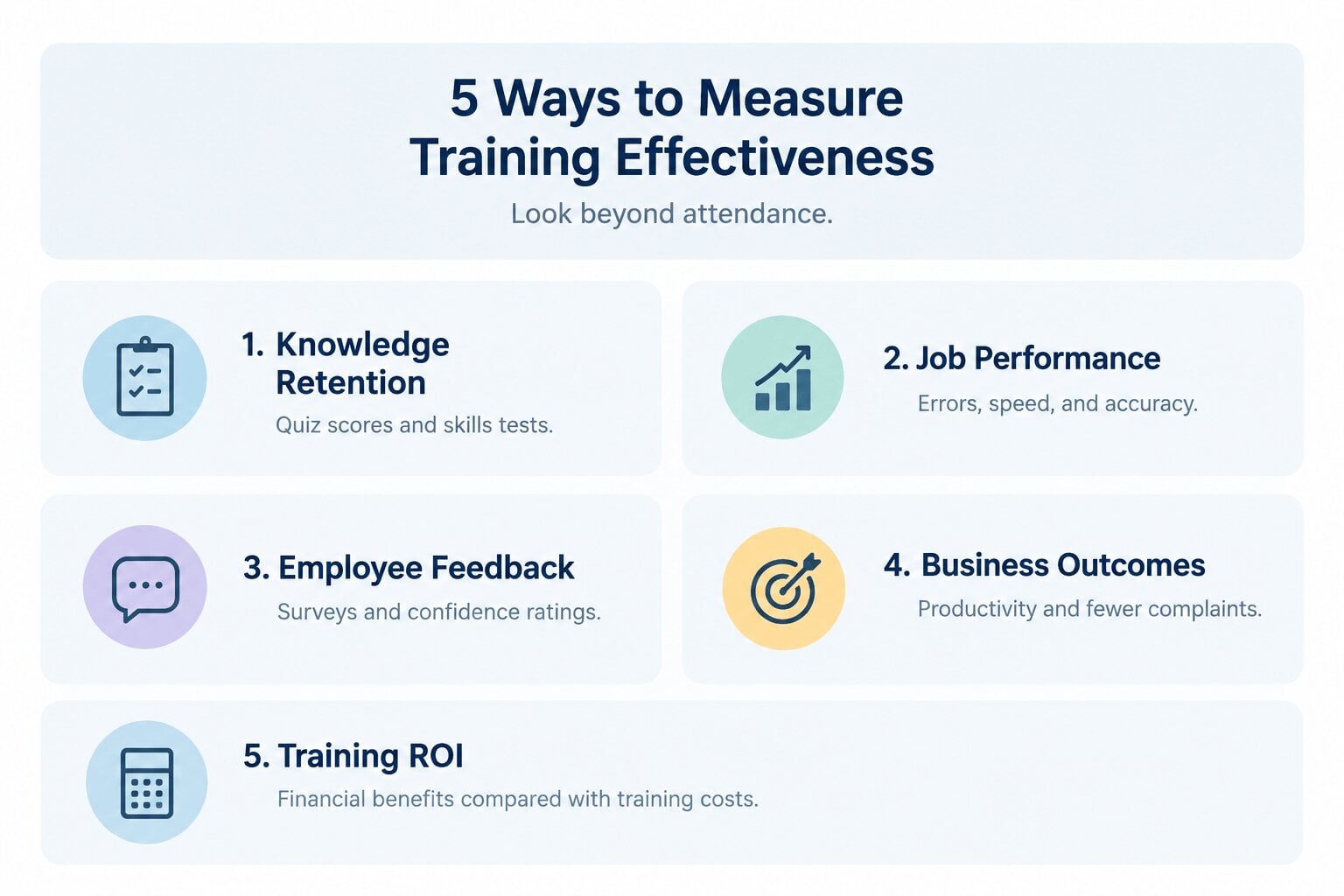
You can measure employee training effectiveness by tracking knowledge retention, changes in job performance, employee feedback, and business outcomes. The right metrics depend on what the training is supposed to achieve and what you want employees to do differently afterward.
1. Check Knowledge Retention
Start by checking what employees actually learned. A short quiz, practical test, or skills assessment can help you see whether they understood the material instead of simply sitting through a session.
For example, if you’re training employees to use new software, ask them to complete a task without step-by-step guidance. Their results will tell you more than attendance records ever could. Keep it practical.
This is especially useful when creating employee training videos, since employees may need to revisit instructions or demonstrate a specific skill after watching.
If you’re unsure whether video is the right format for your team, here’s how to know if you need employee training videos in the first place.
2. Track Changes in Job Performance
Learning something and applying it at work are two different things. I would pay close attention to whether employees make fewer mistakes, complete tasks faster, or follow procedures more consistently after training.
The metrics will vary by role. For customer support teams, you might track resolution time or recurring complaints. For warehouse staff, order accuracy and picking errors could be more useful indicators.
A 2024 peer-reviewed study surveyed 541 employees who had completed workplace training. It found that training transfer and knowledge sharing significantly affected individual and organizational results.
Give employees enough time to apply what they’ve learned before drawing conclusions. A quick improvement is encouraging, but consistent performance over several weeks gives you a clearer picture.
3. Gather Employee Feedback
Ask employees what they thought of the training. Keep the questions simple, such as whether the material was easy to understand, which parts were confusing, and what they still need help with.
Feedback helps you spot problems that performance metrics might miss. An employee could pass a test but still feel unsure about applying the process independently.
I also think the format deserves attention. Some topics work well in a live demonstration, while others are easier to explain through animation or a screen recording. Exploring different employee training video types can help you choose a format that suits the subject and the people learning it.
4. Measure Business Outcomes
LinkedIn’s 2025 Workplace Learning Report found that 88% of organizations were concerned about employee retention, and providing learning opportunities was the number-one retention strategy among surveyed respondents.
This is where training effectiveness becomes more meaningful to the business. Look at the results the training was intended to improve, such as fewer customer complaints, lower error rates, shorter onboarding periods, or increased productivity.
Say you introduce a training program to reduce data-entry mistakes. Compare the error rate before and after the training. If errors fall from 12% to 5%, that’s a useful improvement to investigate.
Just remember that training may not be the only factor involved. New software, staffing changes, or revised procedures could also affect the results. Compare similar periods and consider what else changed before attributing every improvement to training.
5. Calculate Training ROI
If you need to justify the budget, look at the financial return. Training ROI compares the monetary benefits of training with its total cost.
A basic formula is:
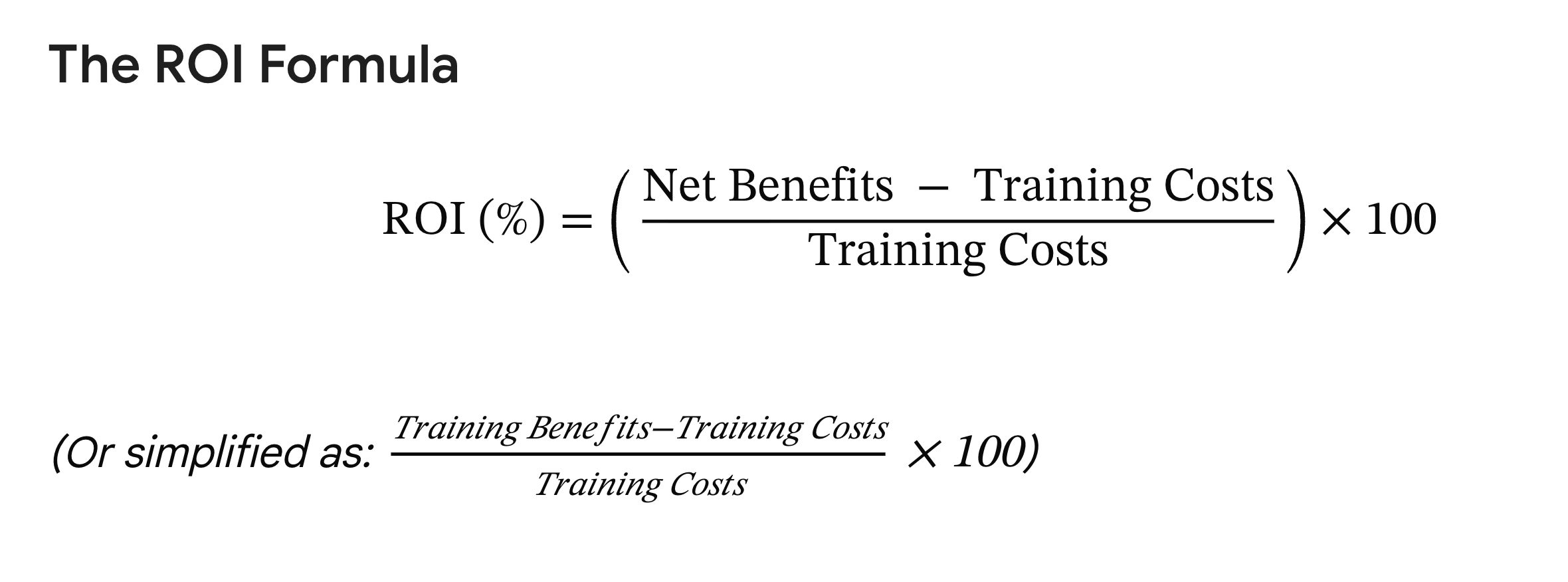
Training ROI (%) = [(Monetary Benefits − Training Costs) ÷ Training Costs] × 100
For example, suppose a training program costs $5,000 and generates an estimated $8,000 in savings through fewer errors and less rework. Its ROI would be 60%.
If you want to dig deeper into training ROI, I found this D2L article particularly helpful: Training ROI: Proving the Business Value of Learning.
Keep the calculation realistic. Include production costs, employee time, software, and other relevant expenses. If you’re producing training videos, it’s worth understanding why video projects can get more expensive than expected before setting your budget.
ROI isn’t always easy to calculate, especially when the benefits are better communication or stronger employee confidence. That’s fine. Use financial measures where you can, and combine them with performance and learning data for a more complete assessment.

How Can You Improve Employee Training Based on the Results?
Use the results to identify where employees struggle, which training methods work best, and what needs to change. Then adjust the content, delivery, or follow-up activities and measure the results again to see whether the changes help.
Identify Knowledge Gaps
Start with the areas where employees consistently get stuck. Low assessment scores, repeated mistakes, or questions that keep coming up can point to a gap in your training materials.
You don’t always need to rebuild the entire program. Sometimes, a clearer explanation or a short demonstration is enough to help employees understand a difficult task.
Adjust the Training Format
The way you deliver training matters. A long presentation might work for explaining company policies, but demonstrating a complicated process could be easier with a video employees can pause and replay.
I’ve seen how much the format can affect communication through my work at Breadnbeyond. When a process is difficult to explain with words alone, animation or screen recordings can make the steps easier to follow. For onboarding, it’s worth considering what a good employee onboarding video should include so new hires get the information they need from the start.
The format should fit the learning objective. If you’re deciding between a written guide, live session, or video, consider the difference between onboarding and training videos before choosing what to produce.
Fix Problems in Existing Training Materials
Sometimes, the problem isn’t the employee. The training itself might be too complicated, outdated, or missing important details.
Review the sections that generate the most confusion. If employees repeatedly misunderstand one instruction, rewrite it or demonstrate the task more clearly. For video content, watch out for training video mistakes that waste time, money, and learning, such as cramming too much information into one video or skipping practical examples.
Small adjustments can make a real difference. You don’t need to start from scratch every time something goes wrong.
Measure the Results Again
After making changes, check whether the same problems continue. Compare assessment scores, performance metrics, or employee feedback against your earlier results.
Give the updated training enough time to work. If mistakes decrease or employees complete tasks more confidently, you’ve got evidence that the changes are helping. If the results stay the same, revisit your approach and test another adjustment.
I prefer treating training as an ongoing process rather than a one-time project. Employees’ responsibilities change, tools get updated, and new challenges appear. Reviewing your training regularly helps keep it useful.
Make Every Training Session Count
Measuring training effectiveness gives you a clearer basis for deciding where to invest in your team’s development. If you’re considering video as part of that investment, Breadnbeyond can help you turn complex information into engaging, easy-to-follow animated training videos tailored to your business.
As an explainer video studio, we work with you to communicate the right message to the right audience, so your team has a resource they can actually use.
FAQs About Measuring Employee Training Effectiveness
How Often Should Employee Training Effectiveness Be Evaluated?
Evaluate training shortly after completion, then follow up after employees have had time to apply their skills. For ongoing programs, quarterly reviews can help you spot trends and decide when updates are needed.
Who Is Responsible for Measuring Training Effectiveness?
HR teams typically coordinate the evaluation, but managers and team leaders play an important role in observing employee performance. In some cases, department heads can help connect training results with broader business objectives.
What Is the Kirkpatrick Model of Training Evaluation?
The Kirkpatrick Model is a framework for evaluating training across four levels: reaction, learning, behavior, and results. It helps organizations assess everything from employees’ initial responses to the broader impact of training on business performance.
What Is the Difference Between Training Effectiveness and Training Efficiency?
Training effectiveness measures whether a program achieves its intended learning objectives. Training efficiency considers how well those objectives are achieved relative to the time, money, and resources invested.
What Tools Can Help Measure Employee Training Effectiveness?
Learning management systems (LMS), online assessment tools, employee surveys, and performance management software can help collect and organize training data. The best choice depends on your organization’s size, training format, and evaluation needs.