
Table of Contents ×
- 1 Is Video Content Really Better Than Everything Else?
- 2 What are the Things You Need To Consider When Making A Social Media Video?
- 2.1 1. Consider your brand
- 2.2 2. Pick the right channel for Your Brand
- 2.3 3. Don’t avoid live videos
- 2.4 4. Consistency is important
- 2.5 5. Think about SEO
- 2.6 6. Consider paid ads
- 2.7 7. Don’t be stingy
- 2.8 8. Call-to-action is crucial for conversion
- 2.9 9. Importance of attention-grabbing
- 2.10 10. Communication with fans
- 3 Which Social Media Platforms Should You Use?
- 4 How to Start Social Media Video for Marketing?
- 5 Mini FAQs About Social Media Videos
Social platforms like Instagram, Facebook, and X have changed a lot over the years.
If you’re using them for marketing, you’ve probably noticed that getting attention isn’t as easy as it used to be.
But to stand out there, you don’t always need ads.
Trust me, organic reach still happens when people actually engage with your content, whether liking it, sharing it, or watching it all the way through.
According to a report, 73% of people prefer watching a short video to learn about a product or service.
Those platforms you open daily know this, too, which is why video content gets priority.
If you want your social posts to reach more people, video isn’t just a nice add-on anymore.
Let’s jump into ten facts of social media videos you have to know.
Is Video Content Really Better Than Everything Else?
Yes, most of the time. When you scroll through social media, you’re way more likely to stop for a short video than a block of text. People watch, share, and react to videos more often because it’s simply easier. You don’t have to commit much time or effort.
Data backs this up, too. Studies predict that around 70% of internet traffic is video, driven mainly by mobile usage.
And if you’re on your phone (like most people are), watching a 1–2 minute video feels a lot more natural than reading a full article.
That doesn’t mean written content is useless. It still has its place, especially when you need depth or details.
But if your goal is to grab attention fast and get people to engage, video usually does the job better.
So no, video isn’t better at everything, but when it comes to social media, it’s often the smartest place for you to start.

What are the Things You Need To Consider When Making A Social Media Video?
There are a few things you should think about first. A small decision, like the video length or how you open the first few seconds, can make a big difference in whether someone keeps watching or swipes away.
Here are some top tips that are going to guide you through the creation process:
1. Consider your brand
No matter what type of content you’re creating, you always need to consider what kind of impact it will have on your brand.
Videos are usually the first point of contact between a company and a new client, and as such, they have to support the organization’s values.
Given that videos have many more elements than traditional articles, there is a bigger chance of doing something wrong.
This means you have to be attentive when it comes to script, surroundings, sounds, lighting, atmosphere, and everything else.
Take your time writing the script and deciding on the overall concept, because one rushed, controversial sentence could destroy a company’s reputation.
2. Pick the right channel for Your Brand
Although you can always share content on various platforms, it is best to choose the optimal network.
The issue here is not sharing, but building and maintaining your profile.
For example, if you have a lot of followers on Twitter, you should consider whether or not you should start building a network on Facebook.
Ideally, you should have a strong presence throughout, but nobody has time for that.
In that regard, you might be forced to tweak your videos so they better suit a platform.
For example, Twitter allows videos that are up to 2 minutes and 20 seconds long.
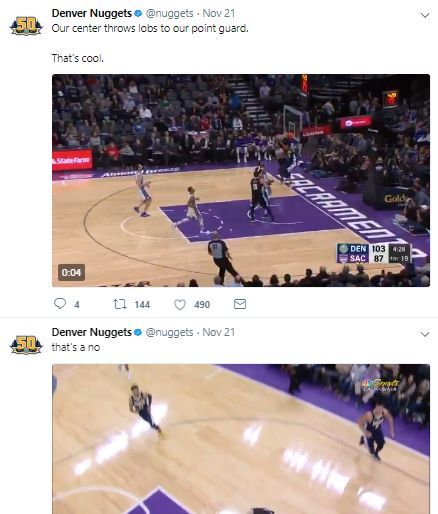
Sports organizations such as the Denver Nuggets post short videos on Twitter as a way of covering live games
3. Don’t avoid live videos
The next thing I wish to discuss is live videos.
While videos are definitely an interactive form that gives you a lot of freedom, there are a lot of people who are not using them the right way.
What do I mean by that?
A lot of companies are focused too much on promotional videos. They usually avoid live ones, thinking that this wouldn’t be the right approach.
Still, the live form allows you to get in touch with your most loyal fans.
At the same time, if a user subscribes to your YouTube channel or joins your Facebook group, they will instantly get notified when you release new content, increasing interaction on that very day.
4. Consistency is important
It is definitely important to have a unique message that will connect consumers to your brand.
However, it is also important to be consistent when it comes to that message.
There is only a handful of videos that manage to get enormous attention on the first try; most companies have to try over and over again. In these situations, consistency comes into place.
Whether we are talking about using one and the same watermark, thumbnails, or conversational tone, it is necessary to show consistency.
The user needs to be able to recognize your video without reading the name of a company.
If your audience liked your videos, it’ll be easier for them to find and check out your future content.
5. Think about SEO
Even though this article is dedicated to social media, you shouldn’t close the door to search engine optimization.
Unless you’re focusing on selling products and services exclusively on social media, it is necessary to consider SEO.
Certain queries are tailor-made for videos
Whether we’re talking about Google or YouTube, you have to find keywords that are easy to rank for and can provide you with a lot of web traffic.
This means you have to perform keyword research beforehand instead of simply writing on topics that you wish to write about.
Even if you have an enormous following that converts to sales, it is never bad to get more traffic through search engines. It can be a great secondary benefit.
6. Consider paid ads
Most people never consider ads when they create a social media video. This is especially true when it comes to companies that have a great video production team.
We tend to think that the quality of a video is enough to get us the required attention. Although this may be true to an extent, you can always do better.
No matter how you look at it, it is always good to increase your reach. This is precisely where paid video ads come into play.
Before you start a campaign, make sure to get all the necessary information.
Like with everything else, different platforms have different pricing and different conversion.
For example, even if you’re mainly focused on Instagram and havea loyal followership, your results (if we presume the same conditions) would be much better if you advertised through Facebook.
7. Don’t be stingy
Like with everything else, video content has become highly competitive. The overall situation has significantly changed in the last 5 years.
Nowadays, everyone is trying to promote their brand by using videos, making it much harder to position themselves.
In that regard, you need to consider the video marketing tools that are being used.
If you purchase cheap items, you will be on the back foot from the get-go.
Videos are a long-term investment and something that you will have to do in the future.
So, get a nice camera, lighting in the room where videos are shot, mics, a tripod, and everything else.
Needless to say, if you’re outsourcing videos, make sure to pay extra for better quality.
8. Call-to-action is crucial for conversion
Regardless of the kind of video you’re making, whether it’s an ad or relaxed chatting with fans, it is necessary to add a call to action.
When using YouTube as a platform, there are a lot of options that will send a viewer to your next video, product line, channel, or something else.
However, you are also able to include a custom call-to-action within the video.
By simply reminding a person to subscribe, you can significantly increase your followership, boosting all future content.
Oftentimes, people don’t even realize that you’re offering something else; they may be completely oblivious to your company or services.
This is something you always need to point out.
9. Importance of attention-grabbing
There are a lot of boring, bland videos out there.
Attention-grabbing hooks have become one of the crucial considerations during video production.
Whether we’re talking about high-pitched sound, interesting colors in the background, and a funny intro, there are different ways to make your content stand out.
Always have in mind that the initial few seconds are the most important part of a video.
If you’re unable to create intrigue within this time period, a potential viewer will simply go somewhere else.
10. Communication with fans
Social channels are heavily dependent on subscribers and followers.
They are your fan base, and it’s necessary to keep them happy and provide them with interesting content.
You need to constantly communicate with them, praise them, exchange ideas and thoughts, and accept feedback (whether it’s negative or positive).
It is a lot of work, but it will definitely help you not only promote your current content but also plan future content.
Which Social Media Platforms Should You Use?
There’s no single right answer here—it really depends on who you’re trying to reach and what kind of content you’re creating. Each platform works differently, and what performs well on one might fall flat on another.
Here’s a quick set of recommendations to help you decide:
- TikTok: Best for short, fast-paced, trend-driven videos that grab attention in the first few seconds. Great if you want reach and discovery.
- Instagram: Ideal for short-form videos like Reels, plus Stories for more casual, behind-the-scenes content.
- Facebook: Works well for slightly longer videos and content aimed at communities or broader age groups.
- LinkedIn: A solid choice for professional, educational, or industry-focused videos that show expertise.
- YouTube: Best for long-form videos, tutorials, explainers, and content people actively search for.
To see how these platforms compare side by side, I’ve created a simple infographic that breaks it all down for you. You can choose ones that match your target audience, video content, and preferences.

<div style="clear:both"><a href="https://breadnbeyond.com/video-marketing/social-media-videos/" target="_blank" rel="noopener"><img src="https://breadnbeyond.com/wp-content/uploads/2021/05/Social-Media-Videos-Infographic.jpg" class="img-embed" title="Social Media Videos: 10 Things You Have to Know" alt="Social Media Videos: 10 Things You Have to Know" width="800" height="11790" border="0"/></a></div><div>Courtesy of: <a href="https://breadnbeyond.com" target="_blank" rel="noopener">Breadnbeyond</a></div>How to Start Social Media Video for Marketing?
If you’re new to social media video, this is probably too much to take in. I recommend that you start by planning your social media calendar.
You also need to find topics that are search engine-friendly and, if possible, can be used on different social platforms.
In addition, checking out social media marketing tools to help you manage everything definitely helps.
After you’ve figured that out, it is time to create high-quality videos.
You will probably encounter a lot of issues as you go, but if you’re persistent and follow these tips, I am sure you will find a way to fix them!
Or read our 7 Essential Video Editing Tips Every Beginner Should Know
Mini FAQs About Social Media Videos
1. How long should a social media video be?
Shorter is usually better, especially on social platforms where people scroll fast. For most channels, 15–90 seconds works well, as long as you grab attention in the first few seconds. If the opening doesn’t hook viewers quickly, they’ll likely move on.
2. Do I need professional equipment to make good videos?
Not at all. You can create strong social media videos using just a smartphone, decent lighting, and clear audio. People care more about useful or interesting content than perfect visuals, so focus on the message first.
3. Should I post the same video on every platform?
You can reuse the same core content, but it’s a good idea to adjust it slightly. Each platform has its own formats, ideal lengths, and audience habits. Small tweaks can make a big difference!
4. Is video still useful for B2B brands?
Yes, absolutely! Videos that educate, explain, or show real insights tend to perform well for B2B, especially on platforms like LinkedIn and YouTube. As long as the content is clear and relevant, video works just as well in B2B as it does in B2C.
5. How often should I post video content?
Consistency matters more than posting all the time. It’s better to share one well-thought-out video regularly than to post multiple rushed videos that don’t add much value. So, mark your calendar to decide your posting schedule and stay consistent!