Table of Contents ×
- 1 Why Are 15-Second SaaS Videos Becoming So Popular?
- 2 Can You Actually Explain a SaaS Product in 15 Seconds?
- 3 Where Do Micro-Explainers Work Best in the SaaS Funnel?
- 4 Are Micro-Explainers Only for Social Media?
- 5 What Makes a Great 15-Second SaaS Video?
- 6 Conclusion: When Micro-Explainers Work—and When They Don’t
- 7 Mini FAQs About 15-Second SaaS Videos
15-second SaaS videos work best at the top of the marketing funnel, where they help companies capture attention and create enough curiosity for people to take the next step.
But are they replacing the traditional SaaS explainer video?
If you spend any time on LinkedIn or Product Hunt, you’ve probably noticed that SaaS videos are getting shorter. So, it’s a fair question.
Instead of 90-second explainers, many companies are publishing 15-second clips that highlight a single feature, product update, or customer benefit.
Those super short clips we often call micro-explainers.
Both SaaS explainer videos and micro-explainers can actually complement each other, but how?
I’ll share where each format fits in the SaaS marketing funnel and how to use both strategically instead of treating them as interchangeable.
Why Are 15-Second SaaS Videos Becoming So Popular?
Because they’re easier to consume and easier to produce. Today’s buyers scroll through dozens of posts before deciding what deserves their attention, and marketers have become better at meeting them where they are.
According to Wistia’s 2025 State of Video Report, videos under one minute have the highest average engagement of any video length.
They are a natural fit for awareness campaigns and social media. Moreover, here are more reasons to know.
Short-form content has changed viewer expectations
Platforms like TikTok, Instagram Reels, YouTube Shorts, and even LinkedIn have changed how people consume content.
Instead of sitting through a lengthy introduction, viewers expect to understand the value of a video within the first few seconds, or they’ll keep scrolling.
I don’t think this means people’s attention spans have disappeared.
They’re simply more selective about where they spend their time.
If your SaaS video doesn’t communicate a clear benefit almost immediately, someone else’s probably will.
SaaS buyers consume content differently today
The SaaS buying journey isn’t linear anymore.
Before booking a demo, prospects may discover your product on LinkedIn, visit your website, read reviews, compare alternatives, and watch product videos across multiple sessions.
That’s why a 15-second SaaS video works so well at the top of the funnel.
It gives potential customers a quick reason to learn more without overwhelming them with information.
Once they’re interested, you can guide them to a longer explainer, product demo, or case study that answers the deeper questions they’ll have before making a decision.
AI makes producing micro-videos easier than ever
Another reason micro-explainers are becoming more common is that they’re much easier to create than they were just a few years ago.
AI-powered editing tools can automatically generate captions, resize videos for different platforms, and even repurpose a 90-second SaaS explainer into several 15-second clips.
Instead of producing a brand-new video for every campaign, marketing teams can quickly create multiple variations that highlight individual features, customer outcomes, or product updates.
Also, I don’t think this shift is replacing traditional explainer videos. It’s making them more valuable.
One well-crafted explainer can become the source material for weeks or even months of short-form content across your entire marketing funnel.
If you want to explore SaaS video examples, I’ve compiled them by category here: 10 Best B2B SaaS Animated Video Examples by Category
Can You Actually Explain a SaaS Product in 15 Seconds?
Usually, no. A 15-second video is too limited to explain even a feature, let alone a whole product. However, that doesn’t mean micro-explainers aren’t valuable.
I’ve worked with SaaS companies across different industries, and I’ve yet to see a product that can be fully explained in just 15 seconds.
Most software solves multiple problems, serves different user roles, and offers features that require context. That’s simply too much to fit into such a short timeframe.
What a micro-explainer can do is spark curiosity. You can think of it as an introduction, not the entire conversation.
What fits into a 15-second micro-explainer?
The biggest mistake I see is trying to cram too much into a micro-explainer. That’s a bad idea.
Instead, focus on communicating one idea clearly. A 15-second SaaS video works best when it highlights a single takeaway.
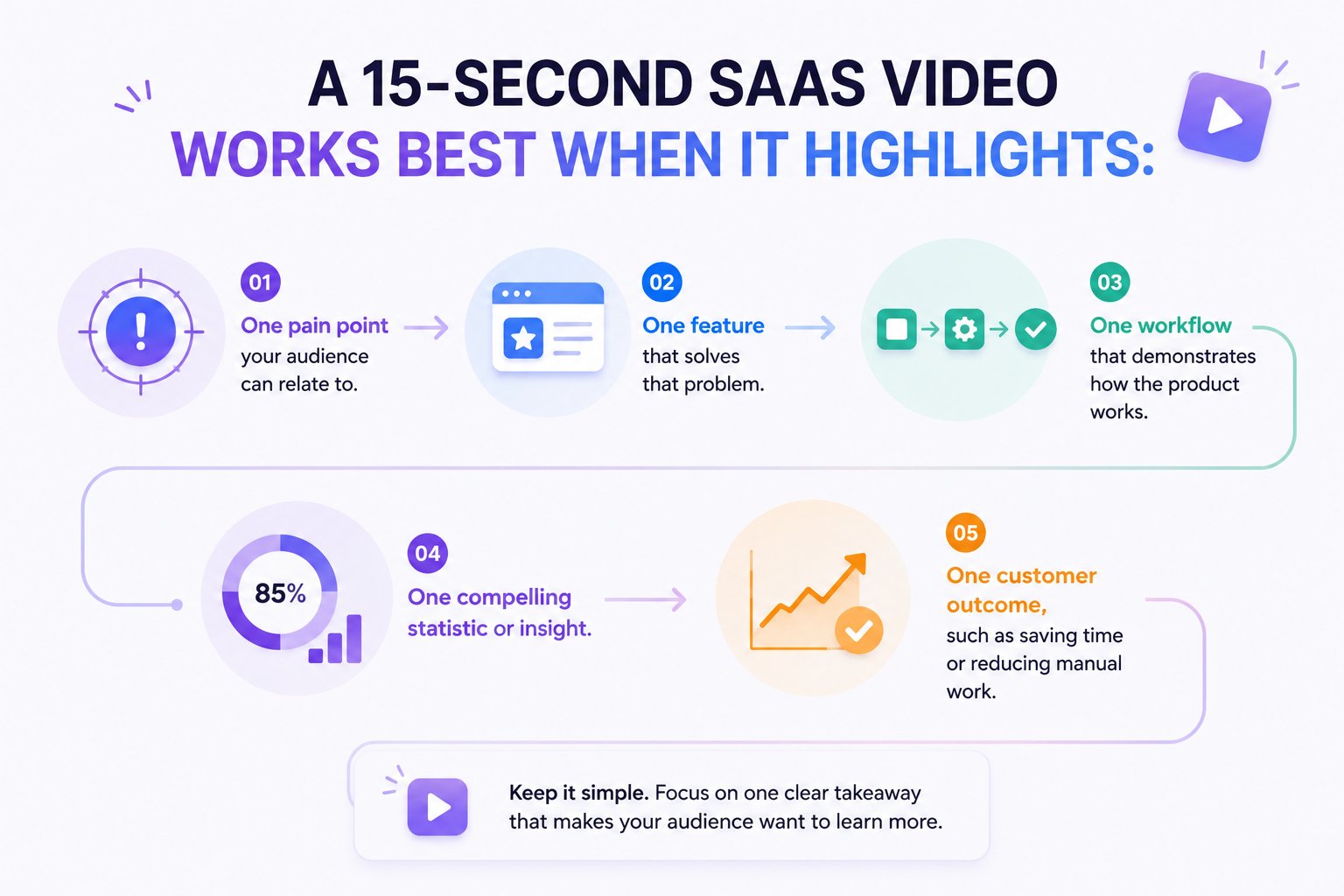
When you do it that way, viewers are far more likely to remember it, and more importantly, click your CTA to learn more.
What doesn’t fit into a 15-second micro-explainer?
Some messages simply need more time.
For example, I wouldn’t expect a 15-second video to explain your entire product story, introduce multiple features, walk through technical integrations, discuss pricing, and position your software against competitors.
Trying to do all of that usually results in a video that’s too fast, too crowded, and forgettable.
That’s exactly where a traditional SaaS explainer video still shines.
It gives you enough time to explain the problem, demonstrate the solution, and connect the dots in a way that builds understanding and trust.
Micro-explainers are best as conversation starters
Rather than asking whether a 15-second SaaS video can replace a 90-second explainer, I think it’s more useful to ask what job each one is trying to do.
A micro-explainer’s job is to earn the next click. It should be compelling enough to make someone watch a product demo, visit your landing page, or explore a specific feature.
The explainer video picks up where the micro-explainer leaves off. It answers the questions your audience naturally has once you’ve captured their attention.
When I plan a SaaS video strategy, I don’t see these formats as competitors.
I see them as sequential touchpoints that move prospects from awareness to understanding to action.
Where Do Micro-Explainers Work Best in the SaaS Funnel?
Micro-explainers for SaaS products are best at the top funnel to build awareness. 10-20-second videos are great to stop the scroll and best to raise awareness in crowded channels like social media.
The biggest misconception I see is that one video should do everything.
In reality, different stages of the buyer journey require different levels of information.
Someone discovering your product for the first time doesn’t need the same video as someone who’s comparing vendors or evaluating features.
When it comes to creating and distributing content through the SaaS funnel, the table below can be your quick guidelines.
| Funnel Stage | Best Video Length | Primary Goal |
| Awareness | 10–20 seconds | Stop the scroll |
| Interest | 30–60 seconds | Introduce the solution |
| Consideration | 60–120 seconds | Explain the value |
| Decision | Product demo | Build confidence |
| Customer Success | Tutorials | Drive product adoption |
At the awareness stage, a micro-explainer has one job: earn attention.
A quick feature preview or customer pain point is often enough to convince someone to keep watching.
Once prospects become interested, they need more context.
That’s where slightly longer videos can introduce your product and explain what it does without diving into every detail.
By the consideration stage, buyers are evaluating whether your software actually solves their problem.
This is where a traditional SaaS explainer video is much more effective, as it has enough time to explain the problem, solution, and benefits in a logical order.
Near the bottom of the funnel, product demos answer practical questions, while onboarding tutorials help customers get value after they’ve signed up.
To me, micro-explainers are better thought of as stoppers rather than replacements.
Their purpose is to create enough curiosity to prompt viewers to watch the next video in the journey.
Are Micro-Explainers Only for Social Media?
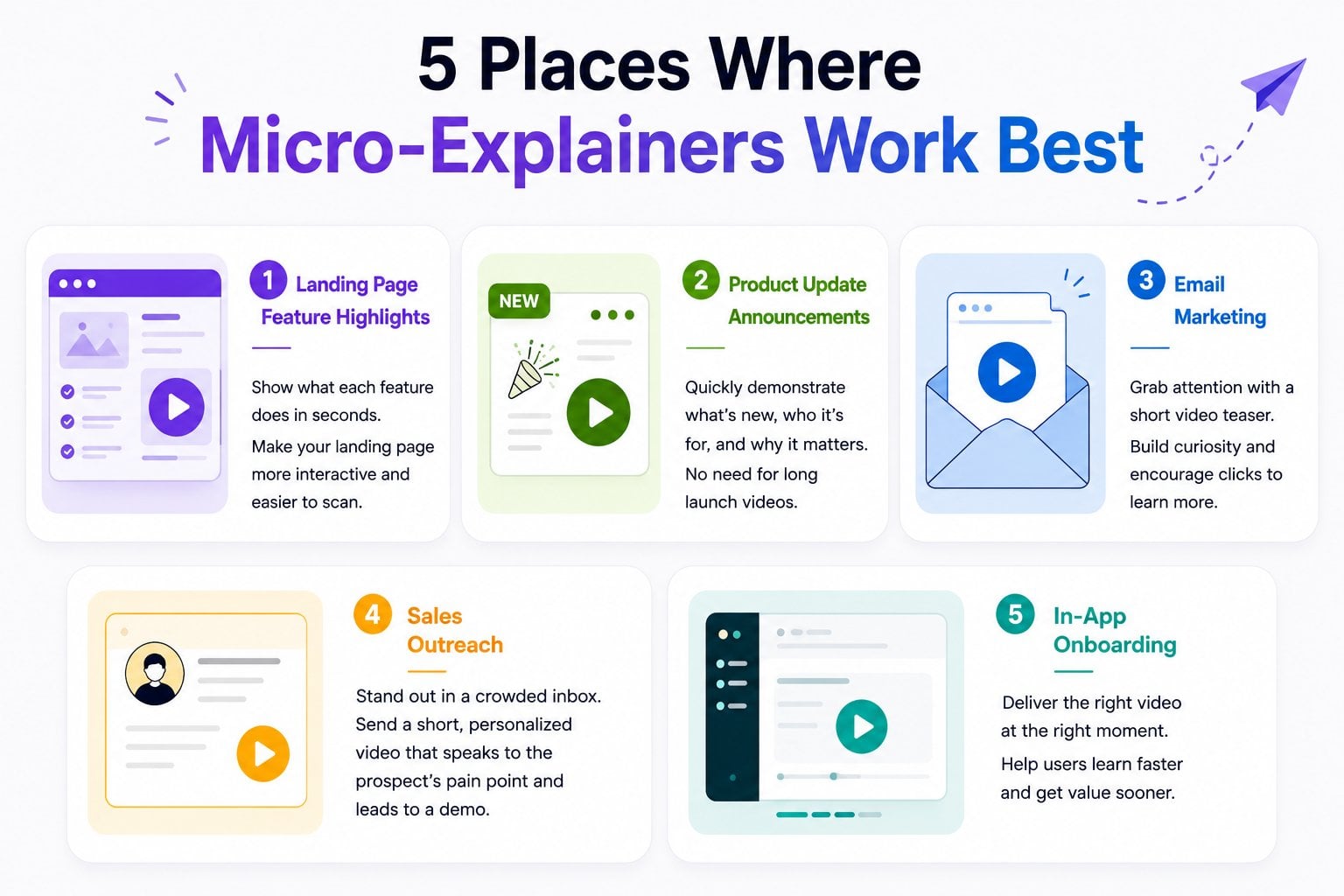
Not at all. While they’re perfect for capturing attention on social media, that’s only one part of their value. The best-performing SaaS brands use micro-explainers throughout the customer journey.
Instead of asking one long video to do everything, they place short videos exactly where users need a quick explanation or a gentle push to keep moving.
What Makes a Great 15-Second SaaS Video?
Creating a great 15-second SaaS video is harder than it looks. Focus on delivering one clear message that viewers can understand almost instantly. With so little time, every scene has to earn its place. You don’t have room for a long setup, unnecessary animations, or a list of features.
Here are some steps you can follow to create a great 15-second SaaS video.
Step #1: Start with one problem
Identify one customer pain point and lead with it.
When viewers immediately recognize a challenge they face, they’re much more likely to keep watching to see how your software solves it.
Step #2: Show the interface immediately
If you’re selling software, don’t hide it.
I’ve seen plenty of SaaS videos spend the first few seconds on logo animations or brand intros. In a 15-second video, that’s valuable time you can’t afford to waste.
Show the product interface as early as possible so viewers immediately understand what you’re talking about.
Step #3: Focus on one outcome
People rarely buy software because it has more features. They buy it because it helps them achieve something.
Instead of listing everything your platform can do, communicate one clear outcome, such as:
- Save hours every week.
- Reduce manual errors.
- Close deals faster.
- Automate repetitive tasks.
A single benefit is far more memorable than five different features competing for attention.
Step #4. End with one clear next step
A micro-explainer shouldn’t answer every question; it should encourage viewers to take the next one.
Whether that’s watching your full SaaS explainer video, exploring a feature page, booking a demo, or starting a free trial, finish with one clear call to action.
If viewers know exactly what to do next, your 15-second video becomes the beginning of the customer journey instead of the end.
Conclusion: When Micro-Explainers Work—and When They Don’t
15-second SaaS videos work best when the goal is to capture attention, highlight a single feature, announce a product update, or encourage viewers to take the next step. They communicate one clear message quickly.
Where they don’t work is when buyers need context. If you’re introducing a complex product, explaining multiple features, showcasing integrations, or building trust before a purchase, a micro-explainer simply doesn’t provide enough time.
That’s where a traditional 60–90 second explainer or product demo becomes much more effective.
The smartest SaaS brands don’t choose one format over the other, but they build a video ecosystem.
A 15-second teaser sparks curiosity, a feature overview expands on one capability, a full explainer tells the product story, and product demos, testimonials, and onboarding videos help prospects become confident customers.
Match the video length to what viewers need at that moment, and you’ll create a smoother journey from awareness to conversion.
At Breadnbeyond, we help SaaS companies create complete video strategies, from micro-explainers and animated explainer videos to product demos and onboarding content.
If you’re ready to build videos that educate, engage, and convert, we’d love to help.
Mini FAQs About 15-Second SaaS Videos
How much does it cost to produce a 15-second SaaS video?
The cost depends on the animation style, level of customization, and production quality. While micro-explainers are generally less expensive than a 90-second explainer, creating multiple short videos can sometimes cost more than producing one longer video that can later be repurposed.
Can I repurpose a 90-second explainer into multiple micro-explainers?
Yes. In fact, this is one of the most efficient content strategies. A single explainer video can be broken down into several 15-second clips, each highlighting a specific feature, customer pain point, or product benefit.
You can read more about repurposing SaaS explainer video in our article: How to Repurpose One SaaS Explainer Video Into High-Performing Marketing Assets?
Which SaaS products benefit most from micro-explainers?
Micro-explainers work particularly well for products with visual interfaces, feature releases, workflow automation tools, AI-powered software, and platforms where a quick demonstration can convey value immediately.
Should micro-explainers be animated or screen-recorded?
Both formats can work. Animated videos are effective for simplifying abstract concepts or introducing a brand, while screen recordings are often better for showcasing real product features and user workflows.
How do you measure the success of a 15-second SaaS video?
Instead of focusing solely on views, track metrics aligned with your goal, such as watch-through rate, click-through rate, landing page engagement, demo bookings, or free trial sign-ups.