I could open this with the usual checklist, AI, short-form video, and personalization. But I’ll spare you the same-old trend report opener. That’s not how 2026 feels from where I’m sitting, anyway.
Over the years, I’ve watched brands like Notion, Duolingo, and Stripe grow without loud marketing, while technically solid campaigns struggled to land.
Running my own company made that contrast hard to ignore. What was supposed to work often didn’t. Simpler, more intentional ideas did.
I’m writing this to unpack that gap: what’s actually holding up, what’s quietly getting filtered out, and how my own perspective on marketing has shifted.
What Kind of Marketing Thinking Actually Holds Up Today?
The kind that values judgment over playbooks, clarity over cleverness, and long-term signals over short-term noise.
When you’re close to real marketing decisions, it becomes obvious which ideas survive pressure and which ones don’t. All because they’re flexible enough to work across different contexts.
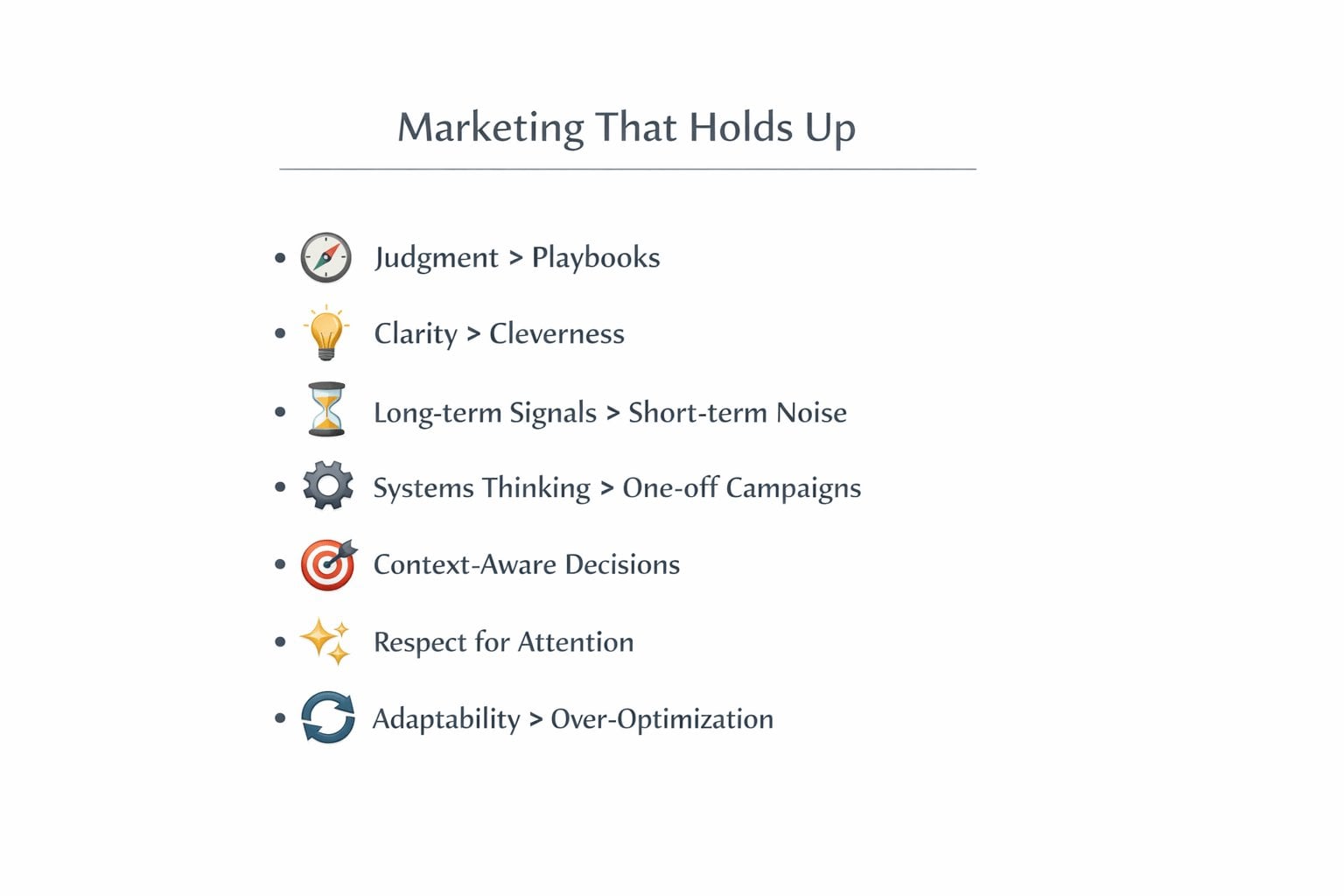
- Thinking in systems, not campaigns. Marketing that lasts isn’t built around one-off launches anymore. It’s designed to compound, where each touchpoint reinforces the next instead of starting from zero every time.
- Clarity as a strategic advantage. Clear messaging scales better than clever ideas. If someone has to pause to understand what you’re saying, you’ve already lost momentum.
- Context-aware decision making. What works depends less on the tactic and more on timing, environment, and audience mindset. The same message can feel right or completely off depending on when it shows up.
- Respect for attention, not attempts to hijack it. The brands that earn attention don’t try to trap people. They make it easier to decide, understand, and move forward.
- Adaptability over over-optimization. Obsessing over perfect metrics often creates fragile strategies. Marketing that holds up is built to adjust when behavior changes.

What’s Actually Happening in Marketing Right Now?
Marketing for years ahead is being filtered. Less survives, but what does survive has to work harder. A lot of what’s happening right now is not always loud or obvious.
There’s no single platform taking over, no tactic suddenly changing everything overnight.
Instead, marketing is going through a kind of quiet narrowing. Audiences are quicker to ignore, faster to judge, and less forgiving of friction.
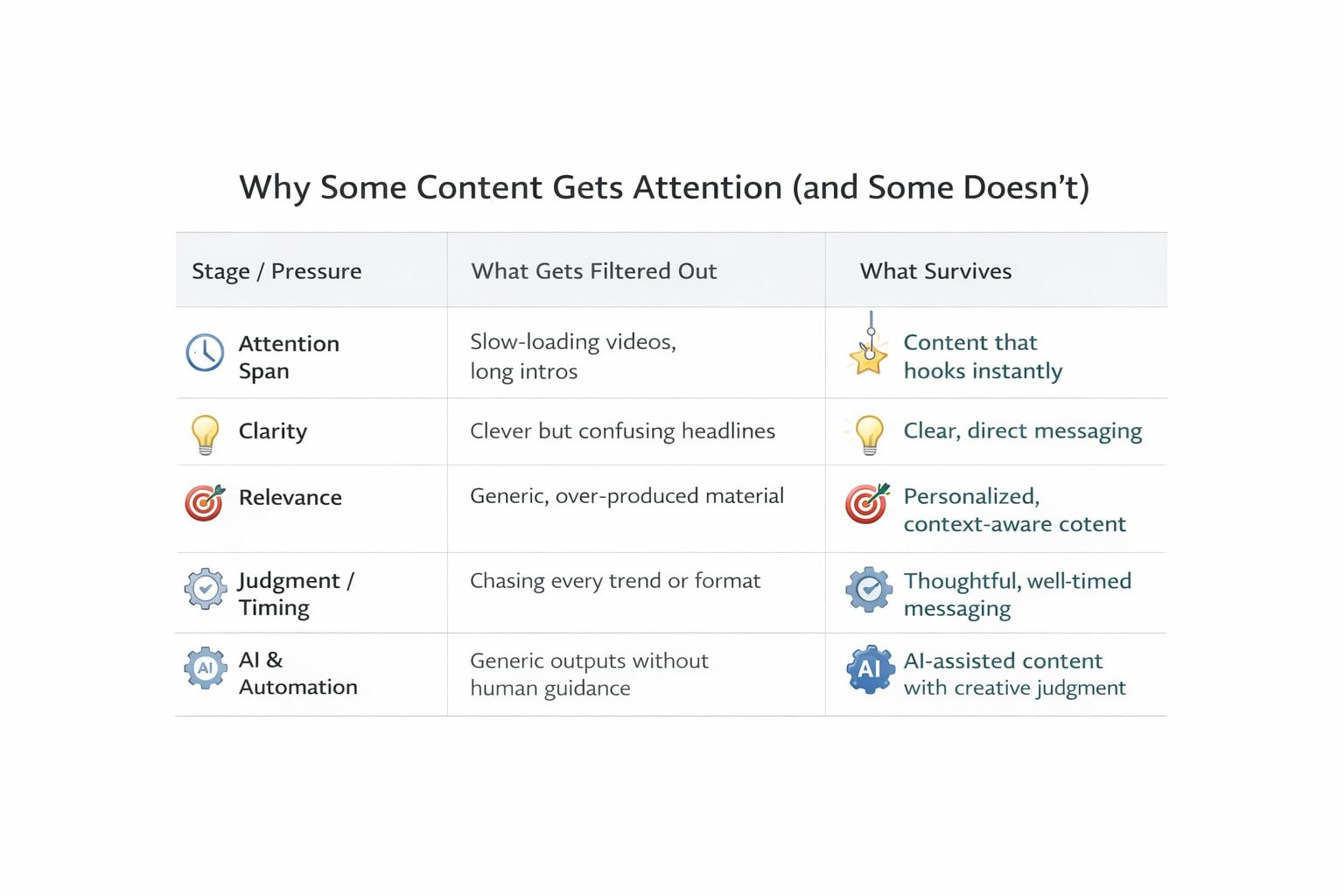
The result is more pressure. Pressure on clarity, on relevance, and on whether something genuinely deserves attention in the first place.
Not Everything Gets Through Anymore
There’s more content than ever, but most of it never earns real attention, which means quality and relevance matter far more than volume.
It feels like we’re drowning in content. And while production is skyrocketing, attention isn’t.
Statistics from SQ Magazine shows one clear signal of this shift is that about 73% of digital content gets abandoned within the first 30 seconds of being encountered, even if someone initially clicked or opened it.
That means most pieces never get a real chance to land.
The audience doesn’t literally consume less media. They become highly selective about what they let in.
Because attention is limited, the brain quickly dismisses anything that feels irrelevant, unclear, or not worth the mental cost.
This filtering happens at every level:
- A headline that doesn’t clearly signal value gets scrolled past.
- A video that takes too long to start loses viewers.
- A homepage that doesn’t immediately communicate relevance gets closed.
The Bar Moved While No One Was Watching
Overly polished brand videos that say a lot without actually saying anything, AI-generated posts that follow the same structure and tone, or “storytelling” ads that build up emotion but never clearly explain the value. They look fine on paper, but audiences recognize the pattern instantly and scroll past.
As one recent marketing priorities survey from UserTesting shows, marketers themselves worry that over-reliance on automation could hurt creativity and authenticity, with 35% citing that exact concern and another 29% pointing to drops in content quality as a top issue in 2026.
Combine that with wider cultural fatigue around overly curated content, and you get a simple reality: people only want to engage with content that feels like it was created for them, not just at them.
Being Clear Is the New Advantage
Most of my clients don’t ask for “more creative” anymore. They ask to be understood faster. They want messaging that clicks in seconds, not something that needs explaining in a follow-up call or a second slide.
Creativity still matters, but only after the basics are clear. If someone has to pause and decode what a message means, interest drops immediately.
In real projects, we see the same three questions come up again and again. Sometimes explicitly, sometimes not: What is this? Who is it for? Why should I care? The video we make that performs best is the one that answers those without friction.
There’s data that backs this up, too. MarketingSherpa case study: When a travel insurance landing page replaced a “clever” headline with a clear, direct one (“Our Travel Medical Insurance has provided peace of mind for over 35 years”), conversion rates jumped by 330%.
Fast Is Easy. Good Takes Restraint
By 2026, speed is expected. Judgment is what separates the work that lasts from the work that disappears. Moving fast is easy now. Choosing what not to do is the real skill.
There’s a useful data point that supports this shift. A Gartner survey found that 73% of CMOs say they’re under pressure to do more with less, which has led many teams to prioritize decision quality over sheer execution speed. When resources are tighter, judgment becomes the real multiplier.
AI Didn’t Replace Thinking
AI makes average marketing easier. It doesn’t make great marketing automatic.
AI tools have removed a lot of friction from marketing. But that’s also the catch. When everyone has access to the same tools, output starts to feel similar.
AI is excellent at filling gaps, following patterns, and producing what already works. It’s far less reliable at creating tension, taste, or a point of view.
You can see this reflected in how teams actually use AI. A McKinsey report notes that most companies adopting generative AI use it to augment existing workflows, not replace strategic thinking or creative direction. In other words, AI speeds up execution, but decisions still come from people.
In our studio, we adapt the same way. We use AI where it makes sense, including to explore directions faster, test ideas, or remove unnecessary friction from the process.
As a tool, it’s incredibly useful. But it works best as a complement to creative judgment. The thinking, the taste, and the decisions still come from people.
What Does “Good Marketing” Even Mean Anymore?
Good marketing today is less about cleverness or scale and more about whether it respects people’s time and attention.
Here’s a simple way to think about what good marketing actually looks like today:
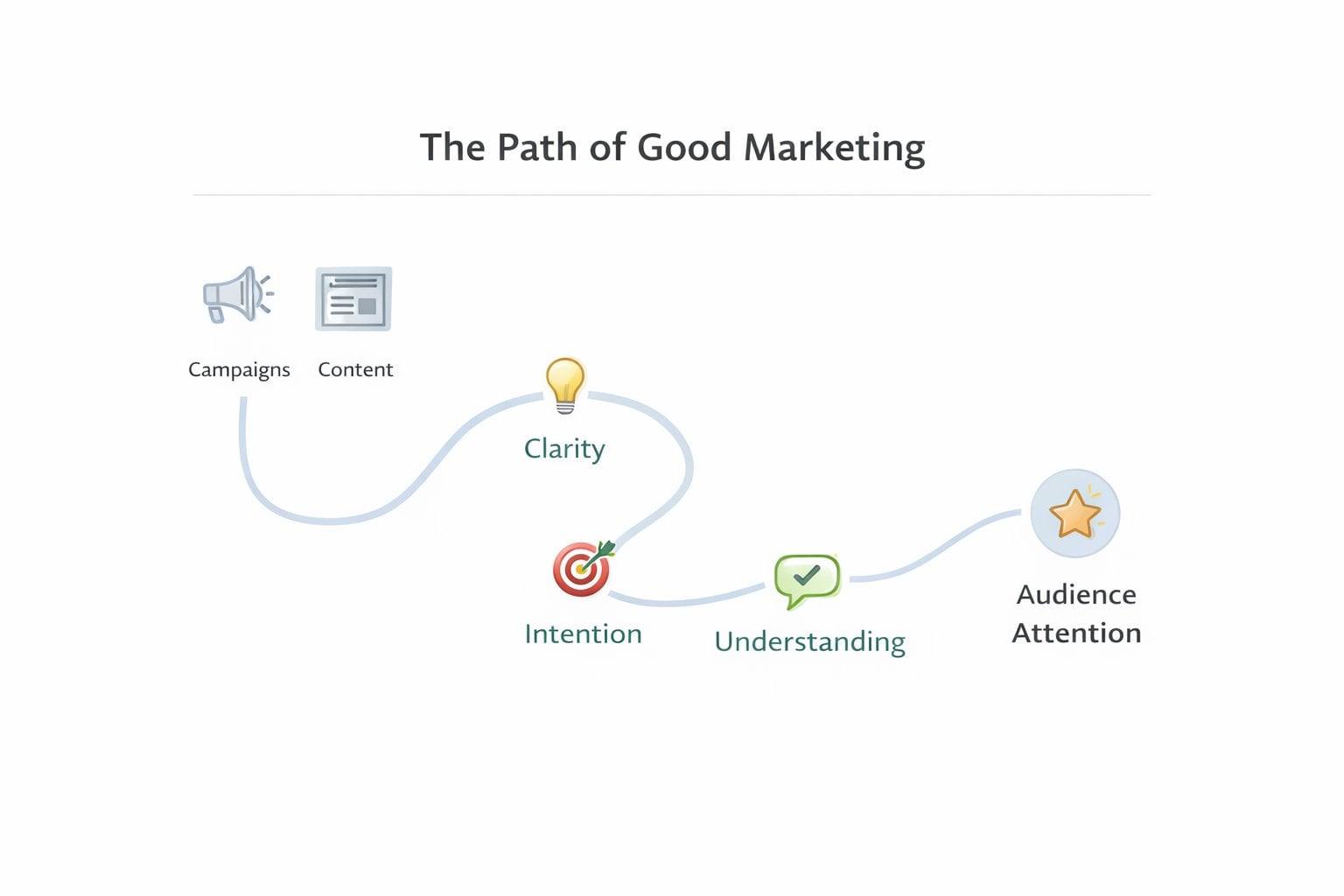
Over time, our definition of good marketing quietly changed. It stopped being about how impressive something looked or how many formats we could ship, and started leaning toward how quickly someone gets it.
Does it make sense without explanation? Does it feel intentional, not forced? Does it respect the fact that people are busy and already overwhelmed?
What’s interesting is that good marketing now often looks almost… quiet. It doesn’t try to win every metric or shout the loudest in the feed. It just shows up with clarity and purpose. And from what we’ve seen, that’s the kind of work that lasts because it’s built around understanding.
GoPro’s marketing rarely explains why the product is good. It just shows it. A short clip, a clean moment, a clear perspective, and you get it instantly. The product disappears, and the experience takes over.

Wrapping Up: What’s Worth Keeping As Everything Changes?
The problem is that too much marketing exists without real, focused intention. We’ve optimized distribution, production, and testing but we’ve been far less disciplined about judgment. So there’s a lot of activity and very little impact.
This shift shows up clearly in our field, the animated explainer space, as well. The work itself isn’t disappearing, but the tolerance for unnecessary complexity is.
Animation doesn’t get a free pass anymore just because it looks good. If it doesn’t clarify, simplify, or genuinely help someone understand something faster, it’s ignored.
What’s working now, and I believe will keep working, is marketing that earns attention instead of assuming it. Fewer messages, clearer thinking, and ideas that are shaped by real understanding.
Mini FAQ: What’s in the Marketing Trends Right Now?
Is marketing actually changing that much right now?
Yes, but not in the dramatic, platform-shifting way headlines suggest. The bigger change is how quickly audiences filter things out. The tolerance for unclear, bloated, or low-intent marketing is shrinking, which quietly raises the bar for everything else.
Does this mean trends don’t matter anymore?
Trends still matter, but mostly as signals, not instructions. They’re useful for understanding behavior, not for copying execution. What works long-term is knowing why something resonates, not just replicating the format.
Where does AI fit into all of this?
AI is becoming part of the baseline. It helps teams move faster, explore ideas, and reduce friction but it doesn’t replace judgment, taste, or clarity of thinking. Used well, it sharpens decisions. Used poorly, it just accelerates noise.
What separates good marketing from forgettable marketing now?
Clarity. Respect for attention. And intentionality. Good marketing makes it easy to understand what’s being offered and why it matters without asking people to work for it.
What should teams focus on if they want to stay relevant?
Fewer initiatives, clearer decisions, and stronger points of view. The goal is to be understood where it counts.