
Table of Contents ×
- 1 How Do You Prepare Before Creating an Explainer Video?
- 2 What Do You Need Before Creating an Explainer Video?
- 3 What Mistakes Should You Avoid When Preparing an Explainer Video?
- 4 How Do You Know You’re Ready to Start Creating Your Explainer Video?
- 5 So, What’s the Takeaway From All This?
- 6 Bonus: Mini FAQ About Explainer Video Pre-Production Checklist
Before creating an explainer video, get clear on your goal, define your audience, sharpen your core message, and outline your script and visuals. But when you work with professionals, you don’t have to figure it all out on your own, they help refine, structure, and turn those ideas into something that actually works on screen.
Even Tony Stark didn’t just snap his fingers and build the perfect suit. There were drafts, tests, and yes, probably a very long checklist behind the scenes. The same goes for explainer videos.
I put this checklist together to help you prep before takeoff so that every second of your video has a clear purpose and direction.
How Do You Prepare Before Creating an Explainer Video?
Don’t start with visuals yet. Start with clarity first. Before you even think about video scripts, storyboards, or animation styles, you need to be clear on what your video is actually trying to say, who it’s for, and what it needs to achieve. When you skip this, everything that follows will likely become a lot harder than it needs to be.
From my experience working with clients, this is the step people rush through the most. At least 97% of marketers say video improves user understanding. But that only works when the message itself is clear to begin with.
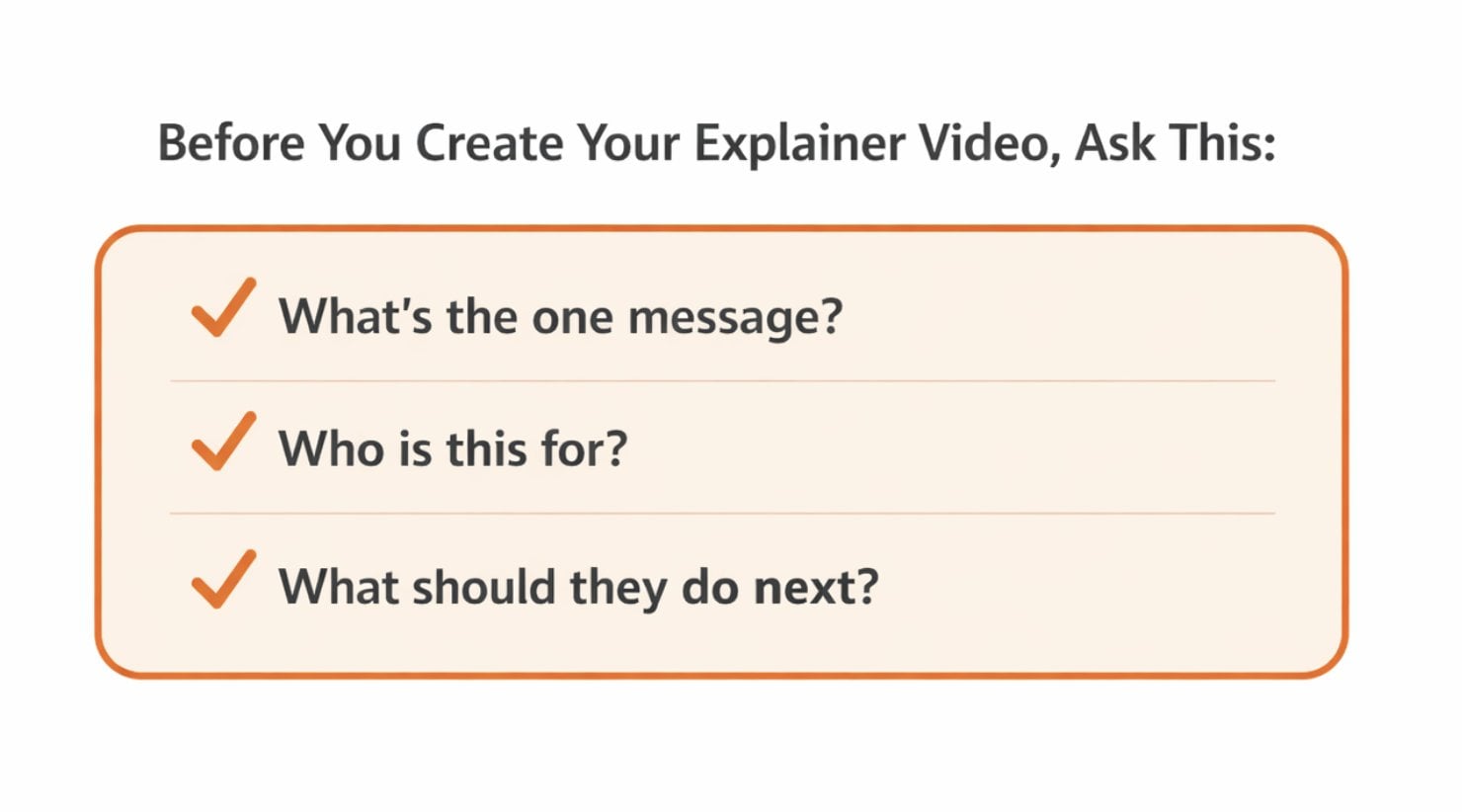
What’s the one message your explainer video needs to land?
If you take one thing from this section, let it be this: your video needs one clear idea. Not your entire product, not every feature. Just the core message you want people to remember after watching.
Who is your explainer video actually for?
Try to be specific here. “Everyone” sounds nice, but it doesn’t help you make decisions. Are you talking to someone completely new to your product? Or someone who’s already considering it? This will shape how simple, detailed, or persuasive your video needs to be.
What action should viewers take after watching your explainer video?
A good explainer video always has a job. Maybe it’s to get sign-ups, encourage demo bookings, or simply help people understand what you do. Whatever it is, be clear about it early, because it will influence how your entire video is structured.
What Do You Need Before Creating an Explainer Video?
Less than you think, but clearer than you expect. You don’t need a perfect script, a full storyboard, or everything figured out. What you do need is enough direction so the video doesn’t feel like it’s guessing its way through.
This is where people either overprepare (and get stuck) or underprepare (and waste time fixing things later). The sweet spot is having just enough to move forward with confidence, without turning it into a full explainer video production before the production even starts.
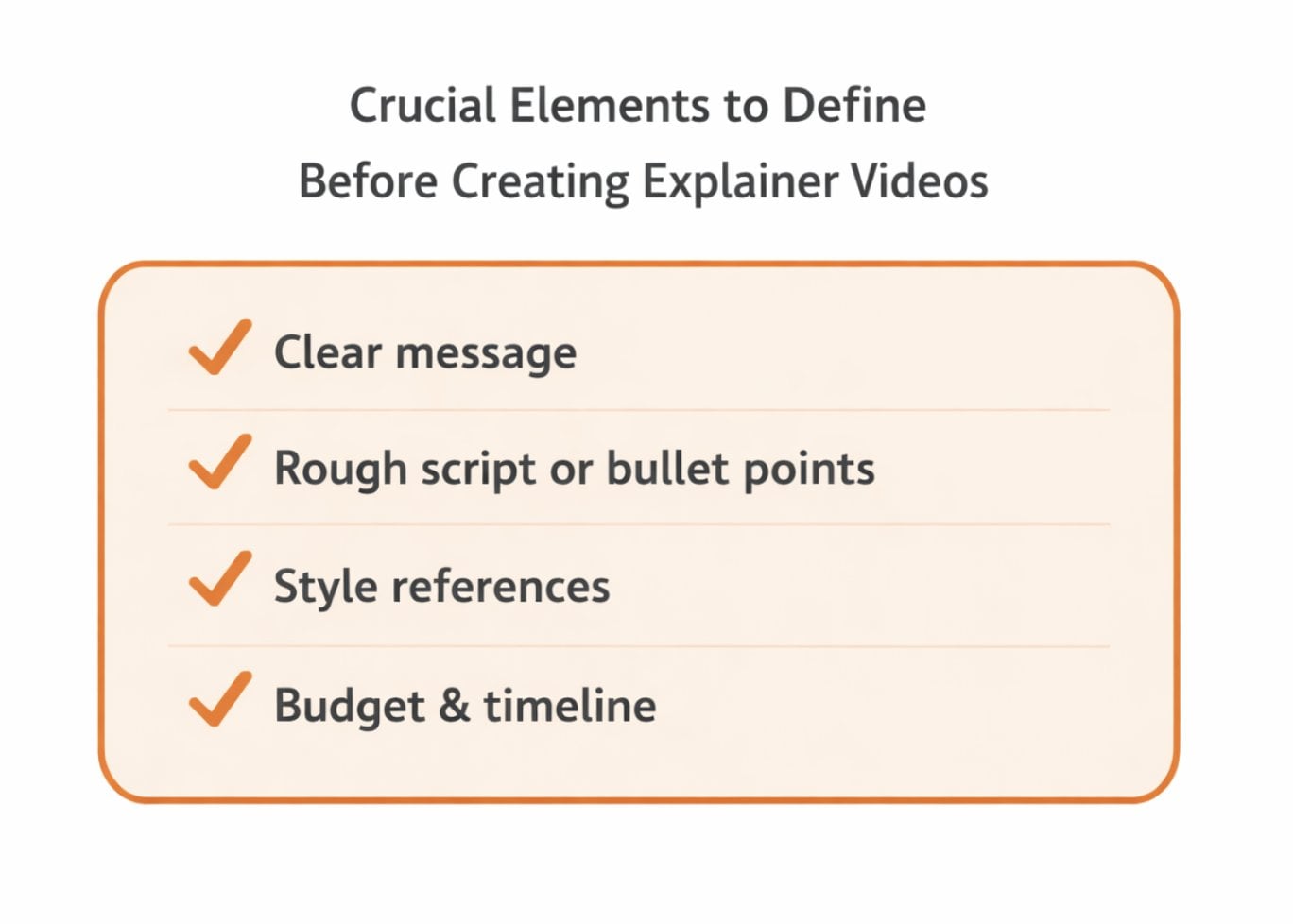
Do you need a full script before creating an explainer video?
Not necessarily. What you do need is a rough narrative.
I’ve worked on projects where clients came in with a polished script, and others where we started from bullet points. Both can work.
What matters more is whether the flow makes sense: problem → solution → why it matters.
If you already have a script, great. If not, don’t overthink it. Even a messy draft or a few key points is enough to get started, as long as the message is clear.
Do you need visual references or style ideas?
Yes, and this is one of the most underrated parts. You don’t need a detailed storyboard, but having a sense of “what you like” saves a lot of back-and-forth later. It can be as simple as a few videos, illustrations, or even brands you resonate with.
I always find that when clients say, “I’ll know it when I see it,” the process takes longer.
But when they can say, “I like this style, but simpler,” or “something like this, but more playful,” everything moves faster.
Do you need to define your budget and expectations early?
Absolutely. And not just for pricing, this affects creative decisions too.
A tighter budget might mean simpler visuals or shorter duration. A more flexible one opens up more room for detail and iteration. Neither is better than the other. It just needs to be clear from the start.
The same goes for the timeline. If you need the video in two weeks versus two months, the approach will be very different.
For example, at Breadnbeyond, a tight deadline may call for simpler visuals, fewer revisions, or a shorter script, while a longer timeline allows more room to refine and expand. See: Breadnbeyond Packages and Pricing.
Do you need everything to be perfect before starting?
Definitely not. If there’s one thing I’ve learned, it’s that waiting for everything to be “final” usually slows things down more than it helps. Explainer videos are collaborative by nature. Things evolve as you go.
What matters is having enough clarity to begin. The rest can (and usually will) get refined along the way.
What Mistakes Should You Avoid When Preparing an Explainer Video?
Short answer: trying to do too much, too fast, for too many people. Most explainer videos don’t fail because of bad animation. They fall apart way earlier, during preparation. I’ve seen it happen more times than I can count, and the pattern is usually the same.
If the prep is messy, the video ends up trying to fix it. And that’s a much harder (and more expensive) problem to solve.
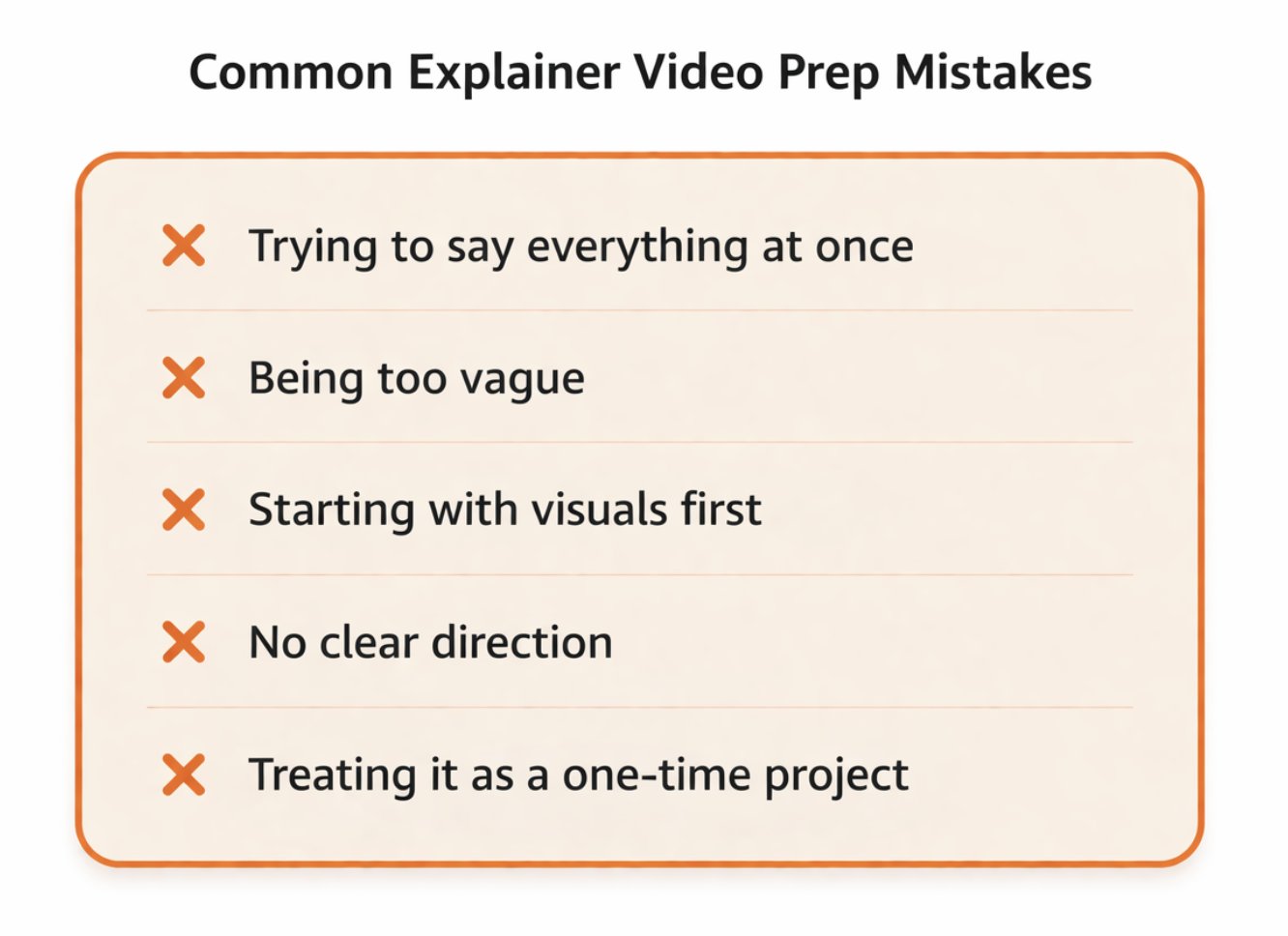
Are you trying to say too much in one video?
This is easily the most common one.
I’ve had clients come in wanting to explain their entire product, all features, multiple use cases, and their company story… in under two minutes. That’s basically asking your video to do the job of your whole website.
Thanos needed multiple movies to make his point. That should tell you your two-minute explainer doesn’t need to carry your entire business on its shoulders.
The more you try to fit in, the less people actually remember. I usually recommend treating your video like an entry point, not the full story.
Are you being too vague to sound “broad”?
This one’s a bit sneaky.
Sometimes in an effort to appeal to everyone, the message becomes… generic. Words like “innovative,” “seamless,” “all-in-one solution”, they sound nice, but they don’t really say anything.
The videos that connect best are the ones that feel specific. They describe a real situation, a real problem. Something the viewer can recognize instantly.
Trying to sound broad often makes the video forgettable. Being specific makes it relatable.
Are you jumping into visuals too early?
This is where excitement usually takes over. People start thinking about animation styles, colors, and transitions before the message is fully clear. And I get it, that’s the exciting part.
If the message isn’t clear yet, visuals won’t fix it. They’ll just make the confusion look better.
Are you expecting the video to “figure itself out”?
This usually shows up as an unclear direction. Things like: “let’s just see what works,” or “we’ll refine it later.” And while flexibility is great, too much of it early on can slow everything down.
From my side, the smoothest projects are the ones where there’s at least a clear starting point. It doesn’t have to be perfect, but it needs to exist.
Are you treating your explainer video like a one-time thing?
This is more of a mindset mistake. Some people put all the pressure on one video to do everything perfectly, forever. But the best-performing brands I’ve worked with treat explainer videos as part of a bigger system.
I wouldn’t treat this as a one-shot project. The real value comes when you see how it performs and iterates from there. You can always refine, update, or create more depending on how it performs.
We worked with Sterling Senior Estate Living. We originally wanted a single explainer video to introduce the community, explain every service and amenity, highlight the lifestyle, answer common concerns, and work across the website, sales presentations, and social media.
But it quickly became clear that one video would be trying to do too much.
Instead, we started with a shorter overview video focused on the main question potential residents and families had: what daily life there actually feels like.

After launch, the team noticed that viewers were especially interested in the wellness and assisted living services. So rather than continuing to add more to the original video, we created a few follow-up videos focused specifically on those topics and used them in email campaigns and consultations.

See more videos at our YouTube channel.
How Do You Know You’re Ready to Start Creating Your Explainer Video?
If you understand your own product and what you’re trying to achieve, you’re already more ready than you think. You don’t need everything perfectly written or mapped out, because that’s exactly where working with the right team makes things easier.
At Breadnbeyond itself, the best projects don’t start with everything figured out. We can start with only a clear idea, then get shaped and refined along the way. That’s literally part of our process.
Do you understand your product and why it matters?
This is the only “must-have.” You don’t need fancy wording or a perfect script. You just need to be able to explain, in your own words, what your product does and why someone should care. If you have that, everything else can be built from it.
Do you have a general goal for the video?
It doesn’t have to be overly detailed. Maybe you want more sign-ups. Maybe you want to make your offering easier to understand. Maybe you just want something solid for your homepage. As long as you know what you want the video to help with, that’s enough to move forward.
Do you have a rough sense of what you like (or don’t like)?
You don’t need a storyboard or creative direction. But if you have references, preferences, or even just opinions like “I want something simple” or “not too corporate,” that already helps more than you think.
And if you don’t? That’s also fine. This is something that usually gets explored together during the process.
Are you open to being guided through the process?
This is where working with professionals really makes a difference. You don’t have to figure everything out on your own. A good team will help you shape your message, structure the script, and turn your ideas into something that actually works as a video.
Do you feel ready to start producing a professional explainer video?
That’s usually the real signal. If you’ve been waiting until everything feels 100% complete, you’ll probably keep waiting. But if you have the basics in place and you’re ready to move, that’s more than enough.
So, What’s the Takeaway From All This?
I’d want you to walk away with these:
- You don’t need every detail figured out before you start.
- Focus on your message and audience first.
- A good studio helps shape rough ideas into a stronger video.
I’d say the process is a lot less about “getting it perfect upfront” and a lot more about shaping it as you go. Remember that you’re not directing Avengers: Endgame.
Scripts evolve. Ideas get sharper.
Things click halfway through that didn’t at the beginning.
And honestly, that’s where working with an explainer video studio can make things feel way less heavy. A good team helps you connect the dots, challenge unclear parts, and turn rough ideas into something that actually works as a video.
Bonus: Mini FAQ About Explainer Video Pre-Production Checklist
Do I need to hire a scriptwriter before starting an explainer video?
Not necessarily. Many explainer videos begin with internal notes, sales calls, FAQs, or even rough bullet points. At Breadnbeyond, our professional scriptwriter can help refine your main message later, so you do not need a polished script to get started.
Should the explainer video be planned differently for different platforms?
Yes. A video for a website homepage is usually longer and more detailed than one made for social media. Before explainer video production starts, decide where the video will live so the format, length, and pacing make sense for that platform.
I’ve talked to some marketers about explainer videos and their best placement here: Where to Put an Explainer Video?
How many people should be involved in approving the video?
Ideally, as few as possible. Too many decision-makers often lead to conflicting feedback and slower revisions. It helps to have one or two key people responsible for final approval from the beginning.
Is it better to create one long explainer video or several shorter ones?
In many cases, several shorter videos work better. One video can introduce the main idea, while separate videos can focus on specific features, industries, or use cases. It is usually easier for viewers to follow and easier for you to update later.
What files or materials should be gathered before production starts?
Besides messaging notes, it helps to collect logos, brand guidelines, fonts, screenshots, product demos, customer testimonials, and any existing marketing materials. Having these ready early can make the production process much smoother.